05. Photonic Computing: When Light Replaces Electrons Forever
Imagine: in five to ten years, relying on electrons shuffling through copper will seem as absurd as powering factories with steam engines. Ready for a world where computing runs on pure light—blazing fast, ice-cold, and practically free?
We’re stepping into the decade that finally retires electricity from the heart of computation. By 2033, the last server rack full of copper interconnects will be decommissioned. By 2035, 99% of all new compute hardware shipped will be fully optical or optical-electric hybrid. By 2040, more than half of the planet’s active processing power will flow through photons—no electrical resistance, virtually zero heat, latency limited only by the speed of light in glass.
And this isn’t theoretical research. Lightmatter, Ayar Labs, Luminous, Celestial AI, and Intel have already taped out real photonic chips in 2024–2025. TSMC and GlobalFoundries are running full photonic process design kits, and 100 Tbps optical switches are already being installed in hyperscaler data centers right now.

Three unstoppable waves already illuminating the future
-
Silicon photonics explodes from prototype to mass production
2025: Ayar Labs’ TeraPHY delivers 4 Tbps optical I/O directly in-package.
2028: Chips hit 100 Tbps with no electrical serializers needed.
2032: True all-optical CPUs emerge—no metal interconnect layers, just waveguides and ring modulators carrying the load. -
Photonic matrix multipliers revolutionize AI acceleration
2026: Lightmatter’s Passage outperforms an H100 cluster by 10× speed and 90% less power on the same workloads.
2030: A single 19-inch blade packs 1 exaFLOPS of optical tensor processing—at just 8 kW total draw.
2035: Reversible optical computing arrives, recycling wasted energy and pushing efficiency to unprecedented levels. -
Free-space and integrated optics fuse into seamless meshes
2029: Room-scale optical interconnects let chips communicate through open air with precision lasers.
2034: Your AR glasses, watch, and wall display form one unified photonic network—no cables, no latency.
What you’ll actually experience by 2030
- A $600 laptop that stays cool to the touch while delivering performance rivaling today’s Frontier supercomputer.
- Data centers without massive cooling towers—just quiet glass pipes and gentle airflow.
- Home internet at 10 petabits per second through a single hair-thin fiber strand.
- AI training jobs that once took weeks now wrap up during your morning coffee.
- Phones and wearables that barely sip power—charging once a year because light does 99% of the heavy lifting.
A regular morning in 2040
You wake up. Your bedroom wall is a vast sheet of photonic glass, idling at 100 petaFLOPS.
You think “render Avatar 4 in full 8K 240 fps”—it’s finished before you swing your legs out of bed.
Your t-shirt weaves 4 Tbps optical links into its fabric.
Your coffee cup beams its temperature reading straight to your neural interface via infrared waveguide.
The entire planet’s computing infrastructure draws less electricity than the United States alone consumed in 2025—while delivering a million times more performance.
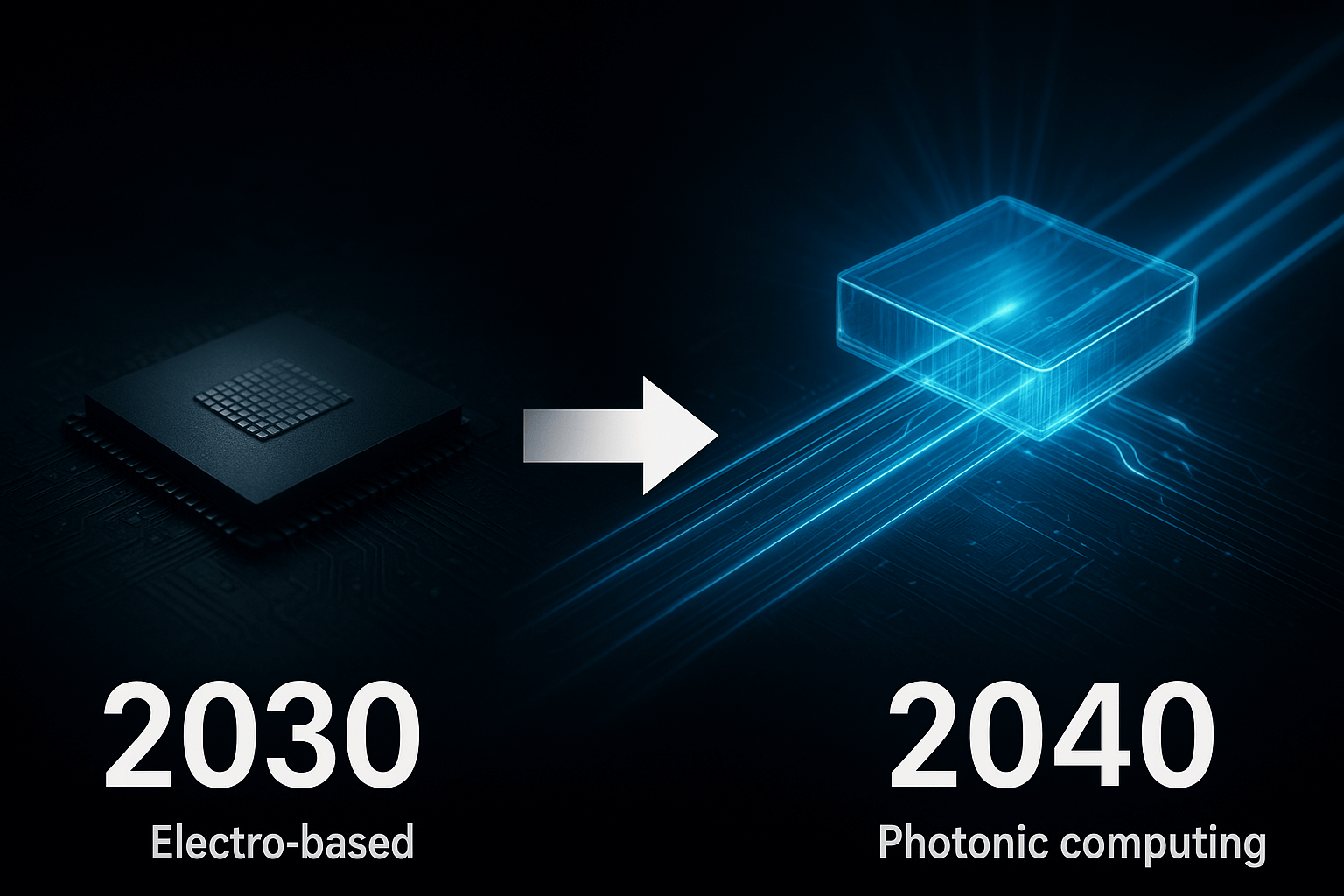
Everything here is already moving into volume production: wafers streaming off lines, photonic servers racked in Virginia and Ireland data centers today.
That whirring fan noise from your current PC will have your children in 2040 asking, “Why did computers used to scream like that?”
Ready for a world that truly runs at the speed of light?